Livestock Resistome inside Global Resistome

by Dr. Paolo Doncecchi, DVM
Global AMR burden and One Health context
As detailed in the previous article, the antimicrobial resistance burden is very complex, and it brings implications not only for the livestock business but indeed for many other aspects of human social life.
We have seen how this burden started in the late 20th century and has increased since then, threatening the global population with a dreadful risk of more than 10 million deaths by 2050 if there is no strong intervention to control AMR.
This burden has created a huge scientific interest in finding the key reasons for antibiotic resistance, defining its sources, and eventually identifying how to control it.
The image below, already used in the previous article in our Academy, perfectly synthesises both the different sources of antibiotic resistance, not only the one linked to the overuse of antibiotics in livestock and fish farms

Visual takeaway: the figure frames AMR as a multi-source issue, showing that livestock antibiotic use is only one component within a broader human, animal, and environmental system.
This is not the place to discuss the last listed topic, the « lack of new antibiotics being developed »: for any further details, WHO regularly publishes open data on this topic. Equally interesting is a recent study describing the « scientific, economic, and regulatory challenges [that] hinder antibiotic development »[1].
Regarding the other five causes indicated by WHO in the table above, it is worthwhile to better detail them through a seminal paper published in 1977[2], which was further elaborated in 2006 through a graphic by Dr. Rebecca J. Irwin, a Veterinary Epidemiologist working for the Canadian Government[3].
The graphic here below shows the crucial modern dimensions and interactions of the five causes indicated by WHO, accounting for broader ecological and environmental pathways and paving the way for the same WHO « One Health » policy[4]

Visual takeaway: the graphic supports the One Health perspective by showing how resistant bacteria and genes can move across animals, humans, water, plants, and the wider environment.
The areas in which antimicrobials are currently used are indicated by circles.
The graphic affirms that AMR is indeed a multifaceted problem, both in terms of its origins and its consequences.
Actually, bacteria can easily jump from the circled areas throughout any other part of the represented environment, generating AMR able to skip any kind of boundaries: there are many potential pathways for resistant organisms to invade individual humans and populations of humans, animals, fish, water sources, and plants.
From antibiotic resistance to the resistome concept
As from the 1st decade of this century, AMR researchers shifted their attention from bacterial populations driving this resistance to their genomes, which are able to circulate this resistance[5].
So: genOME bringing RESISTance → RESISTance genOME → RESISTOME
Focus on the livestock resistome
In this article, we will draw the reader's attention to the LIVESTOCK RESISTOME.
For more details on the Human Resistome, please see the bibliography in note[6].
A livestock resistome refers to the collection of all antimicrobial resistance genes (ARGs) present in livestock gut microbiomes, farm manure, and the surrounding environments of farmed animals, including slaughterhouses and meat processors.
It is primarily driven by veterinary antibiotic use, creating reservoirs of resistance that, via the food chain, air, or water, can spread to humans.
How livestock resistome is analysed through metagenomics
Any resistome analysis in the gut microbiomes of any livestock population (whether small or large) is carried out through metagenomics.
Metagenomics is a molecular biology research technique used to identify the genetic makeup of microbial communities directly in their natural environment.
Metagenomics permits the sequencing of microorganisms' genomes sharing the same sampling site.
So, resistome is the metagenomics of bacteria potentially resistant to antibiotics: the natural sampling environment is the litter (slurry) within a livestock farm.
Final objective: identify ARG subtypes in the litter bacterial population(s).
Two recent scientific examples
To illustrate how livestock resistome analysis helps quantify potential AMR risks, this article details two recent scientific papers that complement each other: the first provides a broad global view across livestock systems, while the second focuses on a specific poultry-related resistance pathway linked to ionophore use.
The first article, « Global health risks lurking in livestock resistome »[7].
The second article, more specific, « The ionophore resistance genes narA and narB are geographically widespread and linked to resistance to medically important antibiotics »[8].
Example 1: Global health risks lurking in livestock resistome
In the first article, the authors analysed the metagenome from the litter of 4,017 farms across 26 countries.
From the 4,017 metagenomic faecal samples, 2,291 ARG subtypes were identified as potentially capable of conferring resistance against 30 different bacterial species.
Furthermore, of these ARG subtypes, 38 are present in 90% of the livestock samples.
Instead, 1,887 ARG subtypes (>82% of the total) were found in only 10% of the farm samples.
Key findings by livestock species
Regarding the different species:
The 38 most frequent ARGs have a different distribution by species:
in 80% of samples of bovine origin → least variation
in 63% of samples of porcine origin
in 47% of samples of poultry origin → greatest variation
If we analyse the number of different ARGs by each species, we can see:
in bovine, the authors found 129 ARG subtypes
in swine, 203 ARG subtypes
in poultry, 246 ARG subtypes
Intermediate conclusions and implications
First conclusion → poultry is the highest potential source of resistance in the livestock business.
Second conclusion → Comparing the data with previously published data on human faecal samples, residential wastewater, and soil, poultry and swine metagenomes contain:
twice the resistome of human faeces
2.5 times the resistome of blackwater
18 times the resistome of soil
Swine is at high risk indeed of creating potential resistance.
By far more critical is the additional information related to the concept of shared ARGs.
They are antibiotic resistance genes found in both animal bedding and humans (faeces and "wastewater"): they were examined against the key antibiotics used in human medicine and the capacity of these shared ARGs to render these antibiotics (partially or completely) ineffective (the figure below synthesises all that is described above).

Visual takeaway: shared ARGs are structurally important because they connect livestock reservoirs with resistance risks for antibiotics used in human medicine.
The higher the number of shared ARGs, the higher the risk of creating (partial or total) inefficacy in human medicine for all the antibiotics indicated in the graphic.
Example 2: Ionophore resistance genes in poultry
The second article focuses only on poultry and specifically on the resistome linked to the use of coccidiostatic ionophores.
The main molecules of this category, helping poultry farmers to control Eimeria spp. poultry coccidiosis, are: lasalocid, maduramicin, monensin, salinomycin, semduramicin, and narasin, and they represent the most widely used anticoccidial feed additives in the world.
Coccidiostatic ionophores derive from Streptomyces spp. and Actinomadura spp., and they have traditionally been considered antibiotics NOT capable of generating resistance.
The fact is that ionophores (also used in cattle as antibiotic growth promoters) possess antibiotic activity. This antibiotic activity can lead to resistance via the plasmids of certain bacteria like Enterococcus faecium, Enterococcus faecalis, and Enterococcus hirae.
This resistance is linked to the genes narA, narB, and especially narAB.
These narAB genes are well spread throughout the world, in all the key poultry markets (indicated in red in the graphic below).
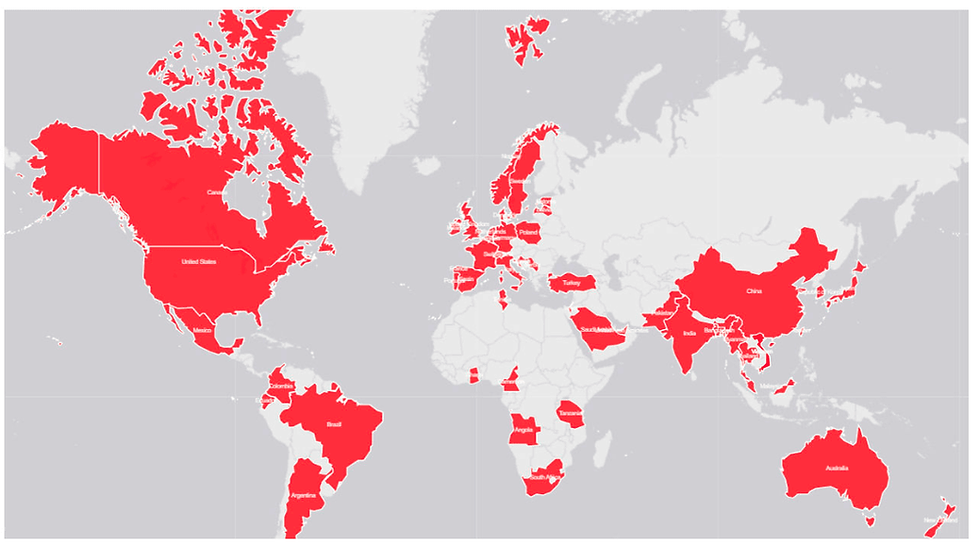
Visual takeaway: the figure highlights that narAB genes are not confined to a local poultry issue but are distributed across major poultry-producing regions.
And these genes create cross-resistance to other livestock species and human populations against different bacterial species (see below).

Visual takeaway: the bubble distribution helps link narAB resistance to specific bacterial hosts and reinforces the concern about possible cross-resistance pathways.
More in detail, this graphic above shows the distribution of narAB genes among bacteria and hosts. The size of the bubbles is proportional to the number of isolates detected with narAB resistance.
Four bacterial species are not in the graph because the sample size was less than 5 counts (Campylobacter jejuni, Cl. perfringens, Listeria innocua and Streptococcus agalactiae).
One conclusion: although not definitively established, narAB gene transfer from livestock to humans appears likely. These observations indicate that the use of ionophore coccidiostats poses a potential risk of clinically relevant antimicrobial resistance.
References
[1] Gargate et alii (2025) npj Antimicrobials & Resistance | 3:50 - https://doi.org/10.1038/s44259-025-00123-1
[2] Lynton A.H. (1977) Vet Rec Apr 23;100(17):354-60 (bibliography not available from Innova)
[4] See our dedicated article on this topic in the Academia section of the Innova Biotechnology Internet site.
[5] Perry J.A. (2014) Current Opinion in Microbiology 21:45–50 http://dx.doi.org/10.1016/j.mib.2014.09.002
[6] Z. Chaudhry et alii (2026) Nature Communications | 17:6212 https://doi.org/10.1038/s41467-026-75659-5
[7] Bintao Li et alii (2025) Sci. Adv. 11, eadt8073
[8] Ibrahim et alii (2025) Antimicrobial Chemotherapy 217.202.27.38.
Author
Dr. Paolo Doncecchi, DVM
Chief Technology Officer
Innova Biotechnology Sp. z o.o.
Warsaw, Poland


Comments